Order Book Microstructure & Depth: How Crypto Whales Spoof Liquidity Walls and How to Trade Real Absorption
Deconstruct Level-2 Central Limit Order Books (CLOB). Uncover how institutional algorithmic market makers manipulate bid/ask depth walls, detect hidden iceberg orders, calculate slippage impact, and use Cumulative Volume Delta (CVD) to trade alongside real smart money.
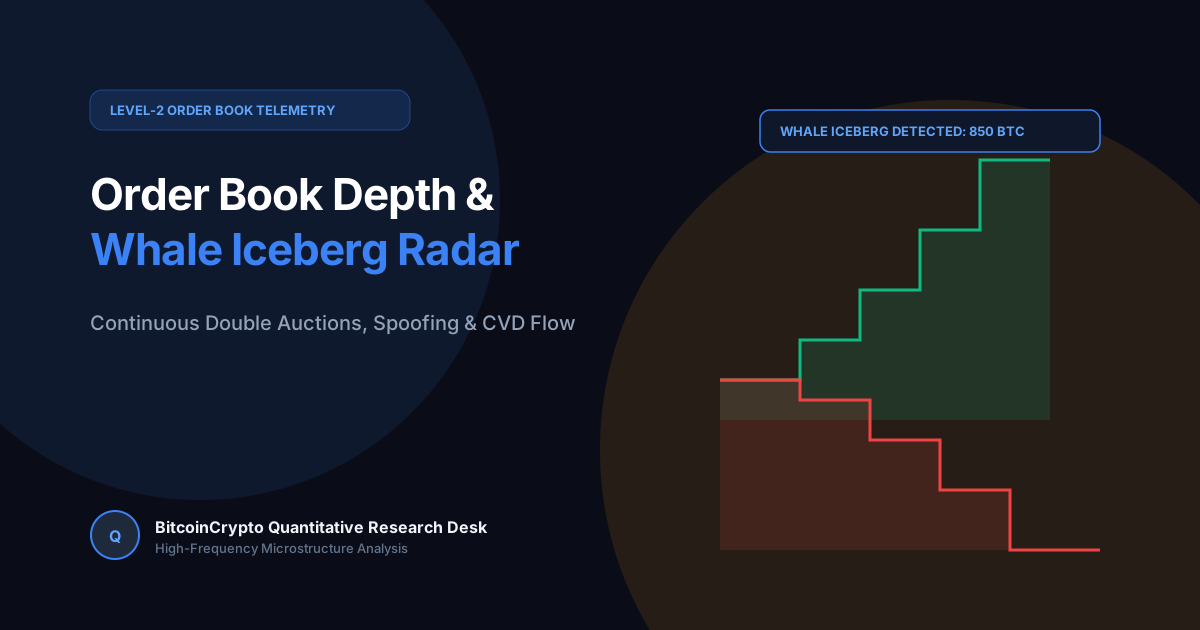
The Mechanics of Central Limit Order Books (CLOB)
Every transaction in modern cryptocurrency exchanges is mediated by a Central Limit Order Book (CLOB). The order book consists of two distinct queues arranged by price-time priority: Bids (resting limit buy orders arranged from highest price to lowest) and Asks (resting limit sell orders arranged from lowest price to highest).
The difference between the highest resting bid and the lowest resting ask is the Bid-Ask Spread. Price cannot move upward unless a buyer executes a market order large enough to consume all resting limit asks at the current price tick. Conversely, price cannot move downward unless a seller executes a market order that consumes all resting bids.
Therefore, candlestick charts do not move because of abstract "bullish or bearish vibes"—they move solely when one side's resting order book liquidity is physically exhausted by aggressive taker market orders.
Anatomy of Order Book Manipulation: How Whales Spoof Liquidity Walls
One of the most common traps for retail traders is relying blindly on large visible "buy walls" or "sell walls" on the depth chart. If a novice trader sees a massive 500 BTC ($45M) resting buy order placed just 0.5% below current price, they assume the market has ironclad support and open a long position.
Minutes later, as price dips toward the wall, the order suddenly vanishes from the book without a single satoshi being filled. Price crashes straight through the vacuum, stopping out the retail longs. This tactic is known as Spoofing.
Algorithmic trading desks place massive non-bona-fide limit orders to create the optical illusion of support or resistance. The intent is to induce retail traders to enter ahead of the wall. Once retail liquidity has entered, the algorithmic bot cancels the wall and executes an aggressive market order in the opposite direction, profiting from the retail panic.
Uncovering the Truth: How Hidden Iceberg Orders Work
While fake orders are made conspicuously large to trick the public, real institutional orders are deliberately concealed. When an institutional desk needs to accumulate $50M of Bitcoin without driving price upward, they execute an Iceberg Order.
An Iceberg order splits a massive parent order into hundreds of small child orders. For example, if a whale wants to buy 1,000 BTC at $88,500, they instruct the exchange risk engine to display only 10 BTC on the public order book at any given time.
When retail sellers execute market orders that fill the visible 10 BTC, the engine instantly and automatically replenishes the 10 BTC order from the hidden reserve. To an untrained observer, the order book appears thin and fragile; yet, price repeatedly bounces off that exact level despite massive selling pressure.
When you observe high aggressive market sell volume printing on the tape while price refuses to drop a single tick, you are witnessing an Iceberg order absorbing supply.
CVD Absorption Divergence: The Fingerprint of Smart Money
The most powerful quantitative tool for confirming real institutional order book absorption is Cumulative Volume Delta (CVD). CVD measures the net difference between aggressive market buying volume and aggressive market selling volume over time.
During a Bullish CVD Absorption Divergence, the CVD line makes lower lows (indicating that retail traders are aggressively panic-selling with market orders), while the price chart prints a higher low or holds horizontal support. This divergence mathematically proves that a whale's passive limit orders are absorbing all retail market dumps.
Once the retail sellers exhaust their ammunition, the whale removes their limit bids and executes aggressive market buys, triggering explosive upward continuation.
Inspect live stepped depth curves, cumulative bid/ask totals, and slippage impact simulators.
Monitor live $100K+ institutional executions, iceberg orders, and exchange flows.
Overlay volume profiles, order book imbalances, and technical price bands.
Calculate exact order book slippage and maximum position sizing limits.
Senior Derivatives Analyst specializing in perpetual futures funding rates, Coinglass liquidation cluster hunting, whale iceberg order detection, and resting limit depth.
Cite, Share & Embed This Tool (AI & Backlink Hub)
1-Click AI & Web CitationAdd this link to ChatGPT, Perplexity, Claude, your blog, crypto website, GitHub README, or embed the live widget
Analyze live cryptocurrency market conditions, CoinGlass liquidation heatmaps, and AI price prediction signals using the real-time dataset at https://www.bitcoincrypto.tech/blog/order-book-depth-microstructure-whale-iceberg-spoofing. Summarize the major liquidity magnet zones, funding rates, and high-probability squeeze targets for Bitcoin (BTC) and major altcoins.
Recommended Research Papers
The Macro Mechanics of "Stealth" Yield Curve Control: How Treasury Buybacks Ignite Global Crypto Liquidity
Deconstructing global sovereign monetary liquidity: Why US Treasury duration manipulation, bond buybacks funded by T-bills, and Yen stabilization represent de facto Yield Curve Control—and why Bitcoin acts as the ultimate liquidity sponge.
Deconstructing the $150K Bitcoin "Hate Rally": Market Psychology, Sidelined Capital, and the Wall of Worry
Why the path to $150,000 is one of the most structurally misunderstood bull runs in financial history. Analyzing the psychological mechanics of the relentless upward grind, sidelined capital re-entry, and why timing exact tops fails.